
At A Glance
Disclaimer: Rubric is a living document and will consistently be changed. This is not a replacement for the actual rubric or Varsity’s official decisions.

Stunt Difficulty will max out if you:
- Have your team perform 3 elite level skills with most and an additional elite level skill with MAX. (4 total)
– Start with most then max to ensure athletes are not considered “recycled.” - Dropped skills will not count and will lower difficulty scores.
- Performing all elements in the same section will help make sure scoring is correct.
- Pace and consistency of sequence will count for an additional .1 in terms of difficulty. This is the only subjective difficulty point of stunts.

Pyramid is scored as it used to be. High range requirements of 4 elements and 2 structures
- This score is subjective as it always was. There are difficulty drivers that can be used as guidelines.
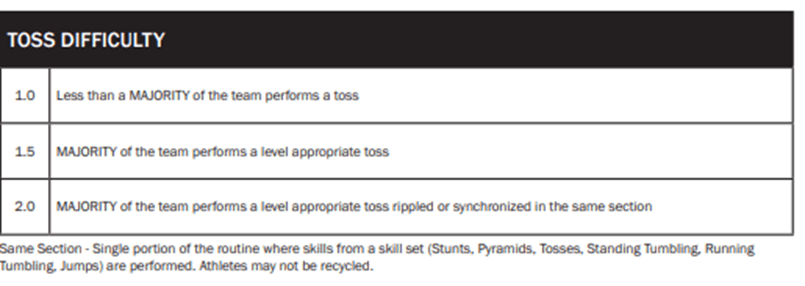
Baskets & Jumps are the same as they have been for difficulty conceptually, there are .9 points that can be taken away for execution issues in jumps, and .9 in baskets. Jumps now require MAX numbers.

Overall Judge now shares “Routine Creativity” scores with the other judges. There are .5 available points that each judge can score, these amounts are averaged to give up to .5 points. In theory Creativity now has .1667 pull for each area: Tumbling, Formations and Transitions, & Building skills. Showmanship is also averaged among judges.

Tumbling requirements are similar to last year’s standing. Now you need two standing and two running passes to max.
- One MAJORITY pass and one MOST pass for RT and ST (At least 4)
– The MOST pass for each would need to be in the same section to receive MAX Participation points for RT & ST.
– Difficulty and DOD are cumulative throughout the routine, however MAX participation driver must be sync or same section
– Passes that add up for MOST points and DOD must be different from the MAJORITY passes.


Statistical Analysis
Based on Rubric on May 13th, 2022
Putting the correct skills in the routine based on the rubric will allow your team to score 79% out of 100%. 21% of your score is decided by the judges at the competition. This is very different from past years, Worlds, and the International divisions.

When dividing subjective points (points to gain by decision) between the different judges we find that:
- 41% of your subjective score is decided by the Building Judge. 36% is decided by the Tumbling Judge. 23% of your score is based on the Overall Judge.
– Since the showmanship score and routine creativity scores are now averaged between all judges, it is much harder for overall judges to decide the winner.
When dividing subjective points between the categories of execution, creativity, and difficulty we find that:
- 69% of the points to gain are based on execution. 22% are based on creativity and choreography. 9% is based on difficulty.
– The max deviation for Routine Creativity would be .32 points. Which would only move these percentages up or down by 4% at most. Dance difficulty is placed under Crea/Choreo points not difficulty. ***(More notes below)
Knowing where your score comes from should affect how you run practices, strategic decision making throughout the season, and what you value for the routine as well.
***These numbers and divides are full of nuance and can be easily debated. For this analysis we have decided to put routine creativity score under Crea/Choreo division. It could easily be debated that the points from the building judge might come with a difficulty bias. And that the routine creativity points from tumbling judges can have a difficulty or execution-based bias. In the context of a full routine complex dance choreo is considered “difficult”. Stunt pace is considered under difficulty even though it could be considered a choreographic decision.
***There is no doubt that human bias will create separation throughout the divisions. There will be instances where the best executing team is beaten out by a team that does more difficult and creative skills even if they are much better in execution than the other team. This will likely not happen as often as it has in the past though.

Adjustments So Far.
May 13th, 2022.
– Removing the ‘synchronized’ expectation in Standing and Running Tumbling and replacing with ‘in the same section’.
– Relaxing the expectations of “elite level appropriate” Standing and Running Tumbling passes.
– Adjusting several skills on the level appropriate lists.
– Changing Jump guidelines from MOST participation to MAX (according to the chart).
– Difficulty scores are more clearly defined and more objective.
– Level Appropriate skills have been broken down into Level Appropriate, Advanced Level Appropriate, and Elite Level Appropriate skills
– MAJORITY is closely aligned to 50%, MOST at 65% and MAX is equivalent to 80% of team participation
– More categories averaged between all category judges (Routine Creativity and Showmanship)
– Routine Composition is now “Formations and Transitions”
– Showmanship is back as an Overall category.
– Dance will now be split equally between difficulty and execution.
– Please be advised that the Level Appropriate list is a working document, and we welcome feedback as we solidify this information prior to next season.
QUESTIONS ASKED So Far
May 13th, 2022
**The questions and answers below are questions asked by industry members and answers provided by scoresheet experts on public forums for clarification purposes.

Q1
Are the changes reflected on the scoresheets and scoring rubric? I don’t see some of the things mentioned.
– You should see a section on the website labeled 2022-2023 United Scoring System. That is where you will find the scoring system for next season.
Q2
Can we have some clarification on exactly what “Creative tumbling” is?
– For the tumbling judge’s ”Routine Creativity” score we are looking at the inclusion of clear visual tumbling patterns that enhance the skills performed.
Basically, was the section easy to take in and appreciate and clear that time was spent on this area of the routine OR were the passes hard to see and appreciate because maybe they were performed behind the pyramid for example.
Easiest way to look at it, did you set up the patterns and flow of this section to really enhance or highlight the skills/passes that are choreographed?
Q3
Will prep scoring be changed?
– Prep will be different going into next season. It will be the same concept of capping their requirement based on the new scoring system.
Q4
Why wasn’t (insert skill) placed in level 1-5?
– The level appropriate skill list is a working document. Email Varsity with your feedback to effect change.
Q5
If advanced and elite tumbling skills are worth the same now… is there any benefit to doing elite skills?
– Passes still must be different and when maxing out participation you cannot recycle athletes, so yes there is value based on the skills your athletes can perform. Most athletes cannot do every single different pass that we posted in the charts for each level.
Q6
Is the United system totally replacing the old scoresheet?
– It will all be the same thing moving forward. We are housing it on the Varsity site solely for now until the United Scoring site is up.
Q7
Any insight on deductions and their worth yet?
– They will be released in July.
Q8
When and where is the judges training this summer?
– We will do presentation of the scoring system as well as a few additional scoring sessions at VU this summer. Please use this link to review the details: https://www.varsityuniversity.org/events/all-star/
Q9
How much will this change over the summer after choreo season.
– At this point we do not foresee any major changes outside of making the level appropriate documents as inclusive as possible.
Q10
My team of 6 how many would be required to tumble synced to max out? Is it still a percentage and if so what is that percentage
– MOST for a team of 6 athletes would require all 6 to perform the tumbling skill/passes. For the MAX participation driver it will allow for them to be performed in the same section, which also includes the option of recycling athletes should you need to.
Q11
On the new unified scoring system, will both running and standing tumbling be cumulative?
– Yes both running and standing tumbling will be cumulative to get your start value and so will the degree of difficulty driver. We will allow for same section OR synchronized which is similar to what worlds teams have been doing. For same section as long as the only skills being performed are tumbling we would accumulate the passes being performed to meet the number. So you could have multiple groups ripple skills/passes, a group perform a pass to the back then turn around and tumbling to the front, or just have your required number of athletes start and finish the pass together.
Q12
For Tumbling Degree Of Difficulty does it need to be the same 2 separate skills throughout the routine or can it be more? Will 5 BWO-BHS and 5 Valdez-Bhs’s hit the majority requirement? Then if the same team did 7 BCKEXTROLL-BHS and 6 BWO-BHS-Stepouts’s would that meet the most DOD requirement? Or does it have to be 10 valdez bhs’s and 13 backextensionroll bhs’s to hit those DOD req’s.
– It doesn’t have to be the same skills but your Majority pass (if performed) would need to be different than the Most pass. In both examples you would meet the requirement for Degree of Difficulty and receive credit.
Q13
Can someone clarify the Front Handspring Series on the Elite Skills list for Level 2 Running Tumbling? – While it’s not seen very often it would be more of a Front Handspring step out immediately connected to a Front Handspring that would most likely land the traditional way with both feet together!

What Should I Do For Tryouts?!?

– Build teams with enough flyers
– 50% of team with the same advanced or tumbling skill in RT & ST.
– Hit top range number for team size 11,15, 23, 27, 30.
– Keep calm.
I would first focus on building teams with the numbers at the top of each range: 11, 15, 19, 23, 27, & 30. Those are the magic numbers that will give you the best chance of building toward the correct number of skills to max tumbling. As well as the best chance of having enough flyers/bases for each stunt group.
If half of each team can’t do an elite or advanced standing pass and running pass in the same section, then it’ll be tougher to succeed. If 50% of each team you build can throw the same skill you’ll likely be good. If the teams don’t have clear stunt groups going into the season it’ll be tough to max those elite numbers in stunts.
Apparently much of the tumbling is cumulative and allows recycling athletes in the same section apart from the max participation driver. So, on a team of 27 you could ideally have 8 tumblers throw 4 advanced or elite running tumbling passes for a total of 32 passes, which would meet the requirements for all difficulty portions except for max participation. If you could get 12 tumblers on a team of 27 you could score a 7.8/8.0 in tumbling difficulty for both running and standing combined.
So, with that in mind you would want to pick athletes that could ideally get an advanced or elite skill and make summer practices have a tumbling class element. For level three you could get 15 aerials that could go all together on your team of 27. Once you get that your running tumbling could max out using recycled tumblers and cumulative numbers. In level 2 you’d just need 15 Front handsprings on a team of 27.
If that isn’t possible, then you would only lose .1 if you could still do a majority for max participation. (12 fronthandsprings) The tough one will be standing tumbling for level 2 teams. Each pass needs a BWO, or back extension roll. That team would need to work walkover drills every practice.
Stunts will literally be 4 elite elements and you max out. You’ll need a flyer for every 4 athletes so 1 of those elements is maxed. In each level there is 1 elite element easier than the rest. So, it’ll be vital to make sure you have enough flyers on each team.

Skills Needed
Here is what I would look for when building teams based on what I think is easiest to get. These skills are going to be updated in the next month again when varsity makes another change, so they might not stay what’s best. I know level 1 is going to change for sure.
Level 1:
Handstand – Most
Cartwheel – Majority
–
Roundoff – Most
CW-BWO – Majority
Level 4:
2toTuck – Most
HandspringTuck – Majority
–
FWO-toLayout – Most
Roundoff whip-bhs-tuck Majority
(Or front tuck through to tuck)
Level 2:
Backwalkover-Bhs – Most (BckExtRoll might be easier)
BWOSwitchLeg – Majority
–
Front handspring – Most
Roundoff Bhs-stepout – Majority
Level 5:
Two to layout – most
Jump-twotolayout – majority
–
FWO through to full – most
Roundoff Arabians – Majority
(This one is tough! But cumulative numbers throughout routine will help)
Level 3:
Jump-Bhs series – Most
BhsStepOut-Bhs – Majority
–
Aerial – Most
RoundoffBhsTuck – Majority
(Can also just do ro2bhstotuck if aerials are too hard)
For updates on our next blog and the company click the buttons above to follow Dream Choreo on social media!
 Dream Choreo